|
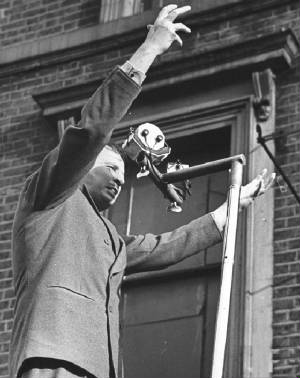
| MOSLEY SPEAKS 1940 |
MOSLEY'S ORIGINS IN THE LABOUR PARTY
Most readers of this paper
will be familiar with Oswald Mosley’s now oft quoted response, from the late 1960s, to The Times newspaper,
“I am not, and never have been, a man of the right. My position was on the left and is now in the centre of politics”
(Letter to The Times 26 April, 1968).
From the beginning, Oswald Mosley was never of ‘the Right’, that lazy political pigeon-holing
practiced unscrupulously by both reactionaries and self-styled ‘progressives’. I have always understood ‘the
Right’ to be that alignment of forces best characterised by a resistance to change, a preference for an old order of
hierarchy and an undying fixation for discipline, punishment and the suppression of the ‘lower classes’. Racism
and suchlike, however, are manifested throughout society and cut across political parties. When he first stood for Parliament
in a Harrow constituency as a young army officer returned from the First World War, he coined the phrase ‘socialistic
imperialism’ which must have confused some of his more strictly Tory electors. He stood as a Conservative Unionist and
won the seat, of course, later opting for a position as an Independent Member of Parliament.
What did he mean when describing his election platform as ‘socialistic
imperialism’? The British Empire was at its height of expansion, enjoying influence across several continents. Britain
truly ruled the waves but the mass of people in Britain still lived in relative poverty. Worse still, many hundreds of thousands
had been conscripted into a terrible war that lasted for four years, involving massive and unnecessary loss of life. Mosley
was a cavalry officer (16th Lancers) who fought in both trench and in air. In those days, officers and men often shared the
same conditions and the same fate. This bond of what he later called “the war generation” was at the core of his
later political motivation and it began, then, on returning, only for him to discover that the same hard faced men, as he
called them, were still in power and had no intention of giving the ex-soldiers a land fit for heroes to live in. Many of
them had made big profits out of that war. Mosley’s ‘socialistic imperialism’ was his response to all that.
Then you would ask, but why
stand as a Conservative Unionist if you want to espouse socialism? Why not simply join the Labour Party of Keir Hardie and
the working man? The answer to these questions can best be explained in terms of Mosley’s social background (a sixth
baronet, a baronetcy going back to the English Civil War on the side of the Royalists) and the class in which he moved. Standing
as a Unionist (as opposed to a trade unionist) came with the title. His bonding with the men of the trenches, however, nurtured
a quite different philosophy.
It
seemed that Mosley was simply looking for an excuse to go over to the Labour Party at the earliest opportunity. After all,
crossing the floor of the House of Commons is not a frequent occurrence and it involves a serious act of deep faith in political
terms. He found it when he took up the cause of the Irish against the use of the Black and Tans in the early 1920s. Not for
nothing did T.P. O’Connor, the Irish Nationalist MP, call Mosley “the greatest friend of Ireland”.
It was in the Labour Party of Ramsay
MacDonald that his ‘socialistic imperialism’ found its true home or so he thought. Not everyone welcomed him there.
Some thought him too ‘socialistic’ and they made that very clear to him. For a few, they resented his
background and wealth and felt rather put in the shade by Mosley’s flamboyant personality. In his first fight for a
Labour seat in Ladywood, Birmingham, he called for the nationalising of the mines, the railways ... and the banks. The Tory
press gave him a rough time and he was narrowly defeated. On December 4th 1926, Mosley was again adopted, this time as the
candidate for Smethwick and he won with a majority of 6,582 — his future in the Labour Party was secured despite the
vicious press attacks. In the couple of years after his defeat at Ladywood, Mosley took time to formulate what became known
as the Birmingham Proposals which were arguments against laissez-faire economics, in favour of planning. They were
radical ideas for curing unemployment, a common theme throughout his political life. He had seen the slums and the poverty
in a few major cities, including Liverpool, and commented, “The re-housing of the working class ought in itself to find
work for the whole of the unemployed for the next ten years”. In my years in Union Movement I recall part of the policy
as “treating housing as a national problem ... *the housing of the people should be taken seriously and treated like
a problem of war”.
Today,
we have the problem of so many empty properties (not slums) along with an army of the homeless. There was a previous government
policy of mass clearance but they failed to replace them with the new, as promised. Mosley would have treated the problem
differently, bringing down costs through methods of mass production.
Mosley’s greatest strength lay in his powerful grasp of economics and it is my contention that he should
have stayed in the Labour Party despite internal opposition to his radical proposals. Even old adversaries like Manny Shinwell
stated much later in 1968 that if he were more patient he would have won and made an enormous contribution to Labour politics
and to the country. To a technocrat like Mosley, fascism had one main appeal and that was the freedom to act, to make things
work, which it seemed was denied him by the old reactionaries within the Labour Party and who still clung to the laissez-faire
economic theories of the previous century. The irony there was that Mosley confessed shortly after the Second World War
that fascism “rode roughshod over civil liberties”, which seemed to cancel out the advantages of unbridled government
action. In the late 1940s he had to all intent and purposes rejected fascism and called for European Socialism instead.
Fascism’s appeal to Mosley was as to
a man concerned with the problems of unemployment and the serious faults within the economic system. It started as a vehicle
for realising his goals, set originally while a member of a Labour government, given the responsibility for curing mass unemployment.
He proposed very radical reforms on Keynesian lines, since adopted by subsequent governments, but were rejected then despite
an appeal to Labour’s parliamentary party. He should have stayed put as most of his closest friends and supporters were
then urging him to do.
This
is what the left-wing historian A.J.P. Taylor meant when he wrote in English History, 1914-1945, “Mosley alone
rose to the challenge ... his proposals offered a blueprint for most of the constructive advances in economic thinking to
the present day ... an astonishing achievement, evidence of a superlative talent”.
Then, the Labour politician, Richard Crossman in 1961, “Capable
of becoming either Conservative or Labour Prime Minister ... revealed as the outstanding politician of his generation ...
Mosley was spurned by Whitehall, Fleet Street and every party leader at Westminster simply and solely because he was right”
... and so the accolades poured forth long after Mosley’s departure from the old party system.
The What If? books edited by Robert Cowley (published
by Pan Books) offer some intriguing hypotheses in the form of essays written by eminent historians. There is one subject missing
in this series of thought-provoking books and it is “If Oswald Mosley had stayed in the Labour government of Ramsay
MacDonald and bided his time”.
I believe Britain would have been a better place if he had.
It is not Mosley the fascist leader that should be celebrated. No, not at
all. It is Mosley the Labour Party socialist that more properly defines his true political home and the cradle of
his ideas as political reformer and economist.
“Parliament invented me”, was a typical Mosleyism. He was the parliamentarian par excellence
and his command of polemic was wasted on the visceral outpourings of fascism. He once said he was tired of men who think
but preferred instead the company of men who feel; which is extraordinary coming from a man with such a brilliant mind. He
was reaching out to the “war generation”, many of whom were then filling the ranks of his Blackshirt ‘legions’
within the BUF.
British
fascism did not miss the potency of the emotional over the essentially intellectual. It made a virtue of it so much so, that
it tended to supersede the latter.
Mosley’s
speeches as a fascist leader, although permeated with some of the more romantic allusions, were fundamentally reasoned and
filled with economic analysis reminiscent of his days in the House of Commons. The parliamentarian always emerged. The ‘fascist’
was simply an adopted mantel.
He
later remarked when being interviewed by James Mossman on a BBC Panorama programme in 1968 that, “I exhausted every
means in the Labour Party of getting my policies accepted before I left. First of all, the Parliamentary Party; secondly the
Conference. And not until I was rejected and defeated in every attempt to get the Labour Party to accept it did I go over
with precisely the same policy — and this is so curious — and start the fascist movement. Having been denounced
as the wild man of the Left by Snowden and others, I was then supposed to become a right-wing reactionary. But my policy was
precisely the same”.
His
policy was indeed the same which would more or less confirm that he had not changed his views but simply the modus operandi
for putting them across. Dressed in his black shirt, he remained a socialist through it all, speaking for Britain and
the British working man. It also explains the fact that British fascism under Mosley’s leadership was not a right-wing
movement ... even though it did attract some right-wing people.
All through the years of the British Union of Fascists and then the considerably longer years of
Union Movement, Mosley the socialist from the old Labour Party shone through like a golden thread of honourable consistency,
never losing sight of that noble purpose coming back from the trenches with the ‘war generation’. The sacrifice
has yet to be atoned.
From the
beginning, it has been the purpose of this publication to put the record straight in face of the many misrepresentations.
If you want to obsess with the fascist phase of Mosley’s career then do so ... but with one stipulation of understanding.
It is that British fascism was no more than a temporary vehicle for a set of ideas that have their roots in the Labour Party.
Those ideas were to transcend issues of political party and organisation. Developed in the Labour Party, they are essentially
socialist in nature. That they were rejected is less an indictment of the Labour Party itself but more a comment on the short-sighted
stupidity of those leading it at the time.
It seems perfectly reasonable to describe the post-war platform as European Socialist, given the
loss of Empire as an economic dimension. Not ‘socialistic imperialism’ in the old sense but a revised European
creed with Europe as the new ‘empire’.
You can not understand Mosley without looking at his parliamentary career and his struggle within
the MacDonald government around the time of 1930. Although he always put Britain first, he was never a nationalist in
the narrow sense, as with the far-right fringe. He further coined the phrase “to do great things in a great way”
... an echo of his proposals as a member of the Labour Party. Nationalism, by its narrow thinking, can only do things in a
small way. Today, they have to blame the Muslims through complete lack of constructive policy.
Unlike “the Right”, supporters of European Action possess
a deeply held collective social conscience. It is a moral regard for others, a desire to solve the great social problems of
this age through changing the system that is largely responsible for most of our ills.
Unlike “the Right”, we have an extensive
policy that would lead to an end to social exploitation and the dominance of international finance (globalism) in the affairs
of nations. We subscribe to the political and economic ideas of Oswald Mosley ... which is why we are European Socialists.
RHE © 2012 European Socialist Action No 38
