[The editor attempts
to answer the many questions from readers concerning the position we take on the National Party of Europe as more than an
idea.]
Nearly sixty years on, many readers of European Action want to know what happened to the concept of a National
Party of Europe and what are we doing about it today. I can first tell them that the idea is kept very much alive through
the pages of this publication and that one of our immediate aims is to spread the word as far and as wide as is possible with
the meagre resources we have at our disposal. For, without the idea and the words that go with it, there can never be its
ultimate realisation.
For this reason, European Action stands as the flagship of the idea, the only truly effective voice of Europe
a Nation in the world today. In the eighteen months of our existence, the paper has steadily grown in political stature;
through perseverance, hard work and resilience we have at last made a name for ourselves in certain important areas of influence.
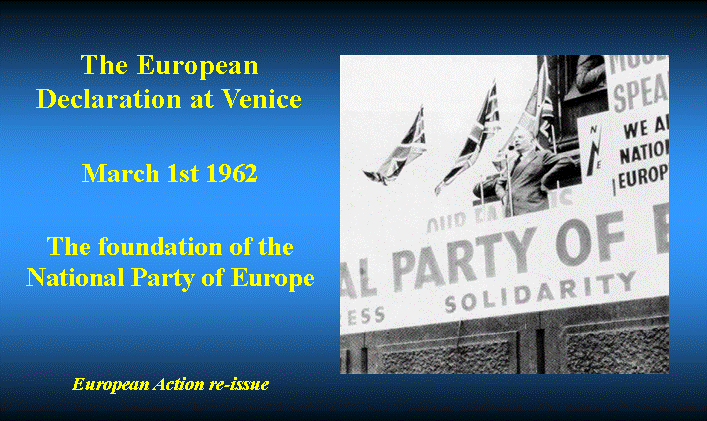
Before then, there was nothing to inspire. We have kept faithful to the original concept formulated by Sir Oswald Mosley and
others at the Conference of Venice way back in March of 1962.
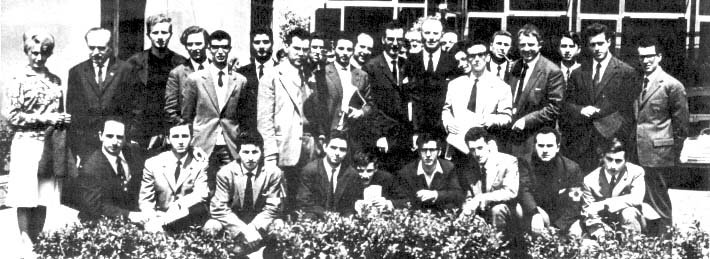
Several nationalist groups across Western Europe (the East was still under
communism) got together to agree on a formula that would establish the existence of a National Party of Europe, this being
regarded as an extension of their patriotism in what Mosley had termed the “higher nationalism” of Europe a Nation.
In our supplement to this issue, we publish the aims and conclusions of that conference ... this being the foundation of the
revived concept as propagated by European Action.
It was said that most of the parties involved at the conference were far
too nationalistic, with some of them enjoying limited later electoral successes as nationalistic groups ... the Italian MSI
being an example. The lesson from this being that the sum total of several nationalistic parties do not make the “higher
nationalism” ... just as a larger number of pygmies will never make a giant. Today, there are some nationalistic
parties that will occasionally pay lip service to the idea of European “co-operation” but will go no further.
It is, after all, pure lip service without any will for going beyond their limited territorial loyalties. Their nationalism
will always be fundamentally anti-European by simple definition of their nationalist titles.
On May 1, 1964, ACTION published an appraisal
by Mosley in which he began, “How stands the National Party of Europe? May 1964 is a good time to make some report
on this matter. The first fact is that the work at Venice stands. It was a very great advance after years of long effort to
secure some effective union between European patriots. Indeed, the success of that conference went beyond my expectations.
We had for years encountered so many difficulties that I did not anticipate such complete accord on our full programme”.
The fact that the
Union Movement and Jean Thiriart’s Belgian party had embarked on an active propaganda campaign immediately after the
conference and that the Germans and Italians had failed in this respect because they were both side-tracked by imminent elections,
left the entire undertaking in a state of quandary.
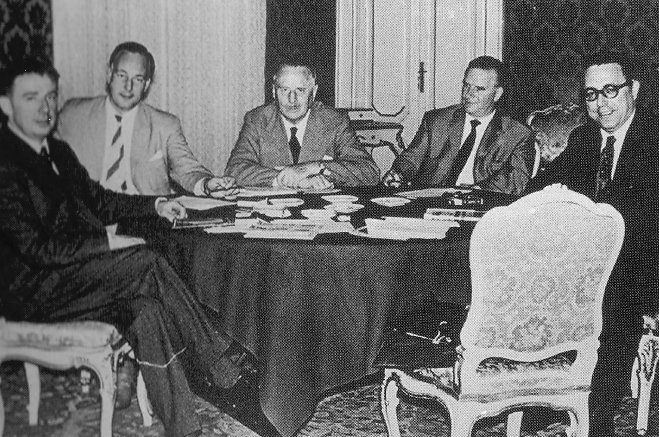
Mosley explained that, for the Germans and Italians, the Declaration of Venice was
a bigger departure from their previous positions. They had considered their separate national interests to be more important.
Perhaps the vital step of setting up a central bureau would have helped things along but Mosley argued that this had failed
to transpire through lack of funding. In his words, “But without the central bureau the practical basis of the National
Party of Europe can not be established. Certainly we can not effectively implement the fifth point of central direction until
we have the means for a central bureau”.
The Nationaldemokratischepartei Deutschlands (the NPD), the successor to
the Deutsche Reichspartei, enjoyed limited electoral success in the mid-1960s but only on a strictly German nationalist
platform. Its leader then, Adolf von Thadden, was given maximum international publicity. This Prussian aristocrat had been
an MI6 agent since 1946, it transpired, his anti-Nazi sister having been executed for treason by the Nazis. With such a family
history it was difficult to realistically view von Thadden as a “neo-Nazi”, a media term then coined to describe
the rising virulent German nationalism.
These points are important when evaluating the potential of the Venice Conference and why it was virtually
suspended .
Jean Thiriart, perhaps one of the most visionary of genuine European unionists, turned towards a form of “national
Bolshevism”, albeit within a European context, which involved seeking an accommodation with the Soviet Union. He took
a very anti-American position in this regard. But his contribution in terms of ideas and theory has been phenomenal and remains
an inspiration to many today.
In 1962, Mosley was to be at the receiving end of a concerted campaign of violence by communists and
Jewish groups in Britain, with Union Movement’s last Trafalgar Square meeting being smashed up by organised Red violence,
even though he was still in his flat in Lowndes Square before leaving for the meeting. Previous meetings in the Square had
passed off without any trouble at all. In fact, previously there was a very successful meeting in which Mosley stood up and
spoke on behalf of the National Party of Europe. The violence followed him to other parts of the country and there is no doubt
the potential success of the Conference of Venice, as reported in the press around the world, was the reason for it all.
They feared our success.
At a press conference in the Union Movement’s Vauxhall Bridge Road offices after the attack upon the last Trafalgar
Square meeting, Mosley said that he did not blame the police for what happened. “But I do”, he said, “blame
the Government for having lost control of the streets to Red anarchy”.
There is no doubt that a campaign for the NPE here in Britain would have
got off the ground were it not for this series of orchestrated violent attacks upon Mosley and Union Movement. With that,
the other parties on the Continent would possibly have felt emboldened to follow suit. As it is, most of them reverted to
narrow nationalistic programmes. But, to Mosley, this was not the end. To him, the Conference of Venice was a success insofar
that it was initially established as fact. In his autobiography My Life he hoped that a future generation would again
pick it up and bring about its reality.
Curiously, on another page in the same issue of ACTION of May 1st 1964, he replies to a correspondent
on the question of what happens in the event of the death or disablement of the Leader. Very rarely was this discussed but
he clarified his position thus:
In this event the Movement will be conducted by a council until a new Leader emerges who will
be chosen by that council. There is no mystery about the council which is already in existence and meets frequently to give
me advice and to perform a variety of duties undertaken by its members. This council is selected on the principles in my article
[see “Union Movement as the New Model Party” in ACTION of March 13th] according to the work men and women
do for the Movement. They are most of them well-known to members of Union Movement. Those among them who will conduct the
Movement in the event of my death are all well-known to members and their names will then be published. In addition at present
we have secondary council members who attend for specific purposes and, on occasion, some whose names can not be published.
The work of the
Movement will be carried on with the same round table method I have advocated and employed in Europe by the people who have
served the Movement best until a new Leader emerges by his proved ability.
A Directorate of Union Movement was established in the mid-1960s, as, soon
after, I became West London Area Organiser when Martin Moloney was appointed a Directorate member. Jeffrey Hamm remained the
Secretary of the Movement with Mosley pursuing his aims, quite successfully, as a man above party politics. He was to remain
the Leader to all of us until his death in 1980.
Now we come to the key point of this article: whither the National Party of Europe
as previously established? It is very clear that any council appointed by Mosley was not successful in pursuing the ideas
of Europe a Nation after his death but reverted to being a kind of memorial society with annual dinners of remembrance being
the year’s highlight. The political Movement had been effectively wound up ... until European Action decided
to remind the world of a great idea.
Where others failed to continue the struggle for whatever reasons, we have picked up the standard
of the Movement. To the Bailey brothers and other members of the Directorate that have passed on, we salute you. Ever loyal
to the Leader, you fought the fight.
Now it is time for the end of reflection and what could have been. Rather we turn to the beginning
of a revitalised vision and what can still be done for our Europe and its people.
The first thing we need to do is to perfect our propaganda good enough and
powerful enough to influence as many of our countrymen as we can. Because, without that, the idea would whither and die.
I would claim that
this publication has the potential, as it stands, to persuade the best of our people in the direction of forming a political
organisation for all Europeans. This is our main aim.
Secondly, we must learn the lesson of the Conference of Venice of 1962. Quite
simply it is that, collectively, the nationalistic parties of the separate parts of Europe are totally unsuited for the creation
of a pan-European political force. We need those who already possess a European consciousness ... people like Mosley and Thiriart
who had been Europeans from the beginning and were Europeans to the end.
This is not a philosophy or doctrine cobbled together for a quick win in
a local election, based on purely populist opportunism and expediency. It is revolutionary and requires patience and hard
work. There is a group of political parties in the European Parliament collectively called “Alliance of Europe of
the Nations” ... each one is strictly petty-nationalist and virulently opposed to European unity. Do not be fooled
by its title because it is the antithesis of Europe a Nation. We have no allies because it is we alone that propagate
this great European idea and we alone who will see it through.
Our position today is very clear. We must make this paper a great success
by distributing it to as many people we should find to be good Europeans. First, is the idea and then the word. Keep alive
the spirit of Mosley’s vision, my comrades, and one day we shall win.